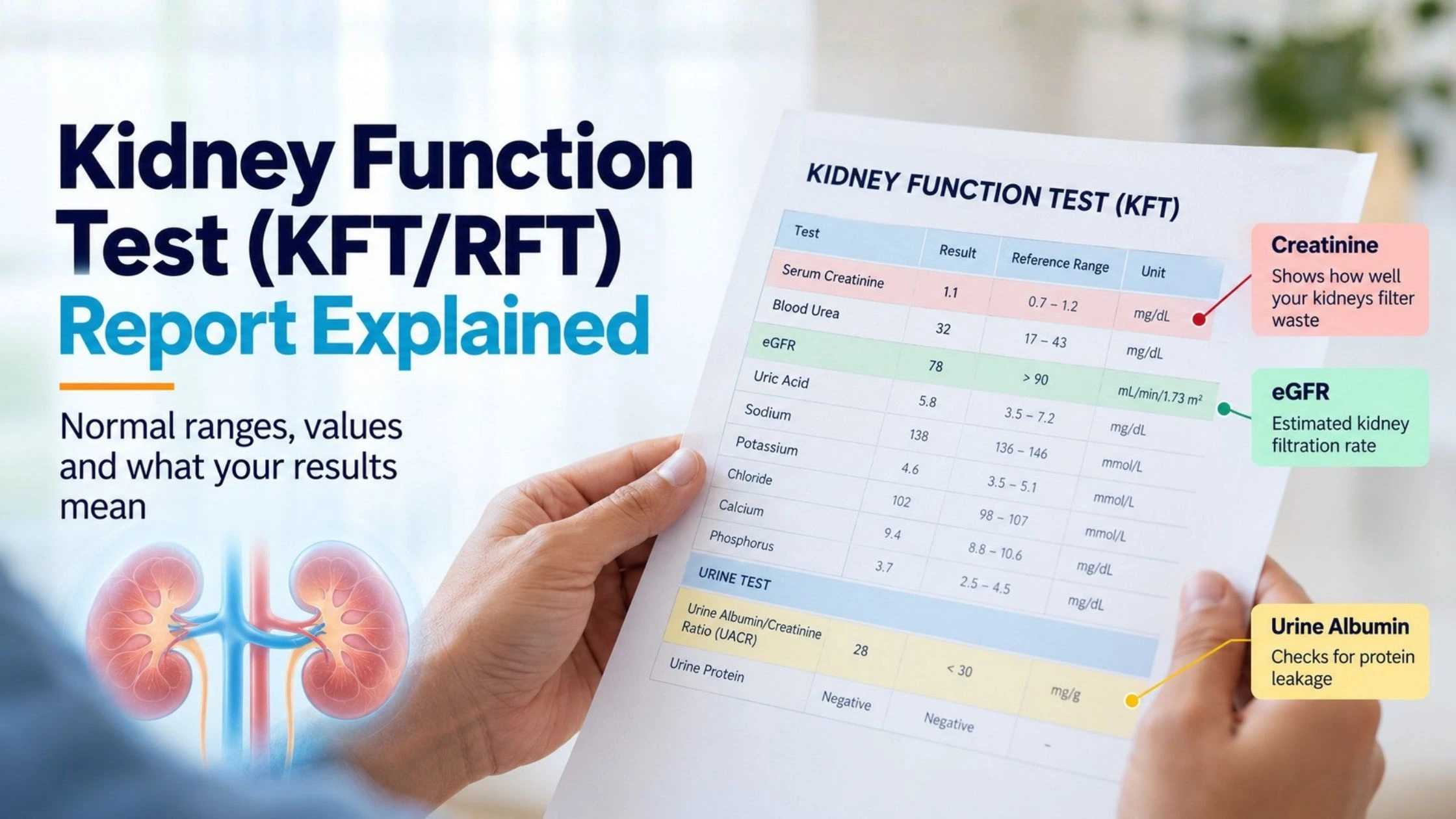
If you have recently received a Kidney Function Test (KFT) or Renal Function Test (RFT) report, the number of values on the page can make it difficult to know what actually matters.
You may see terms such as serum creatinine, urea, BUN, eGFR, uric acid, sodium, potassium and calcium. Some reports may also include urine tests such as urine albumin or urine albumin-to-creatinine ratio (UACR).
You do not need to interpret every number in isolation.
For most people, the important starting points are creatinine, eGFR and urine albumin, along with the other results and your medical history. A single abnormal result does not automatically mean you have kidney disease. The result needs to be interpreted in context and, when appropriate, compared with previous reports.
What is a kidney function test (KFT/RFT)?
A kidney function test, also called a renal function test (RFT) or renal profile, is a group of blood tests, and sometimes urine tests, that show how your kidneys are working. KFT and RFT mean the same thing. There is no single standard panel. Each laboratory builds its own package, so check which tests are included in yours.
What tests are included in a KFT?
A typical Indian KFT or RFT package includes some or all of these:
- Serum creatinine
- eGFR (estimated glomerular filtration rate)
- Blood urea and/or blood urea nitrogen (BUN)
- BUN/creatinine ratio
- Uric acid
- Sodium, potassium and chloride
- Calcium and phosphorus
Your doctor may also order a urine test, such as a urine albumin-to-creatinine ratio (UACR) or a urine routine examination. These look for albumin, protein or blood leaking into the urine.
Kidney function test normal range
Reference ranges differ between laboratories because they use different methods and equipment. Always go by the range printed next to your result. The table below shows commonly reported adult ranges as a guide.
Test | Commonly reported adult range* |
Serum creatinine | Men: about 0.7–1.3 mg/dL · Women: about 0.6–1.1 mg/dL |
eGFR | 90 or above mL/min/1.73 m² |
Blood urea | About 15–45 mg/dL |
BUN | About 7–20 mg/dL |
BUN/creatinine ratio | About 10–20 |
Uric acid | Men: about 3.5–7.2 mg/dL · Women: about 2.6–6.0 mg/dL |
Sodium | About 135–145 mmol/L |
Potassium | About 3.5–5.1 mmol/L |
Chloride | About 98–107 mmol/L |
Calcium | About 8.5–10.5 mg/dL |
Phosphorus | About 2.5–4.5 mg/dL |
Urine albumin-to-creatinine ratio (UACR) | Below 30 mg/g (below 3 mg/mmol) |
*Illustrative ranges only. Your laboratory’s range takes priority.
A value outside the range does not automatically mean kidney disease. A value inside the range does not rule it out either.
How to read your report: creatinine, eGFR and urine albumin
Creatinine
Creatinine is a waste product made by your muscles and removed by your kidneys. When kidney filtration falls, creatinine builds up in the blood.
Creatinine also depends on other things. A muscular person can have a higher creatinine with healthy kidneys, and an older or very thin person can have a “normal” creatinine even when kidney function is reduced. Creatinine can also be pushed up by:
- Dehydration
- A large meat meal in the hours before the test
- Heavy exercise the day before
- Creatine supplements, which are common among gym-goers
- Certain medicines
eGFR
eGFR estimates how well your kidneys filter blood. It is calculated from your creatinine, age and sex. Most laboratories now use the CKD-EPI 2021 equation. It is reported in mL/min/1.73 m².
As a general guide:
- 90 or above: normal or high filtration
- 60–89: mildly reduced. On its own, this does not mean chronic kidney disease.
- Below 60: reduced kidney function that needs medical assessment
- Below 15: severely reduced function, which may mean kidney failure
Duration matters. An eGFR below 60 has to last at least three months before doctors call it chronic kidney disease (CKD). CKD can also be present at a higher eGFR if there is other evidence of kidney damage, such as albumin in the urine. Some Indian reports do not print eGFR. If yours doesn’t, your doctor can calculate it from your creatinine. When creatinine may be misleading, for example with very high or very low muscle mass, your doctor may order a cystatin C test for a second estimate.
Urine albumin (UACR)
Blood tests show how well the kidneys filter. A urine albumin test shows whether the kidneys are damaged and leaking albumin, a protein, into the urine.
A UACR of 30 mg/g or more (3 mg/mmol or more) is abnormal. Albumin in urine can rise temporarily after exercise, fever or a urine infection, so an abnormal result is usually repeated. If two out of three tests over three to six months are abnormal, the albuminuria is considered persistent.
Urine albumin often rises years before creatinine does. This is why people with diabetes or high blood pressure should have a UACR test every year, even when their KFT looks normal.
The other values on your report
Urea and BUN. Both measure nitrogen waste in the blood. Indian reports usually show blood urea; many international websites talk about BUN. To convert, urea (mg/dL) ≈ BUN × 2.14. Urea rises when kidney function falls. It also rises with dehydration, a high-protein diet, bleeding in the stomach or bowel, and steroid medicines, so a high urea alone does not mean kidney disease.
BUN/creatinine ratio. A ratio well above 20 often points to dehydration or reduced blood flow to the kidneys rather than kidney damage itself. Your doctor reads it together with the other values.
Uric acid. High uric acid is common and has many causes, including diet, weight, some medicines and reduced kidney function. It can cause gout and kidney stones.
Potassium. The kidneys control potassium. High potassium matters most, because very high levels can affect the heart rhythm.
Sodium and chloride. Abnormal levels have many possible causes, including fluid balance, medicines and hormonal problems.
Calcium and phosphorus. These can become abnormal in more advanced kidney disease and affect bone health.
When is an abnormal KFT urgent?
Seek same-day medical care if:
- Your potassium is above about 6.0 mmol/L
- Your creatinine has risen sharply within days, for example by 0.3 mg/dL or more within 48 hours, or to one and a half times your usual level
- An abnormal report comes with very little or no urine, breathlessness, swelling that is getting worse, persistent vomiting, or confusion
A sudden rise in creatinine can mean acute kidney injury, which often needs prompt treatment and can recover when the cause is treated.
Book a routine appointment with a nephrologist if:
- Your creatinine is above the range, or higher than on earlier reports
- Your eGFR is below 60, or falling over time
- Protein or albumin shows up in your urine more than once
- You have diabetes or high blood pressure and any kidney value is abnormal
- You notice early signs of kidney problems, such as swelling, foamy urine or changes in how often you pass urine
Frequently asked questions
Is fasting required for a kidney function test?
Usually not. Some laboratories advise avoiding a large meat meal for about 12 hours before the test, because cooked meat can temporarily raise creatinine. Follow your laboratory’s instructions.Are KFT and RFT the same?
Yes. Kidney function test (KFT) and renal function test (RFT) are two names for the same group of tests. The tests included vary between laboratories.What is the most important value in a KFT?
No single value is enough on its own. eGFR shows how well the kidneys are filtering, and urine albumin shows whether they are damaged. Doctors look at both, along with how the values have changed over time.Is urea the same as BUN?
They measure the same waste product in different units. Urea (mg/dL) is about 2.14 times the BUN value. Indian reports usually show urea; some show both.Can kidney disease be present with normal creatinine?
Yes. Creatinine can stay within range in early kidney disease, especially in older or thin people. A urine albumin test and eGFR can detect problems that creatinine alone misses.Can creatine supplements increase creatinine?
Yes. Creatine supplements can raise blood creatinine without any kidney damage. Tell your doctor if you take them, so the result can be interpreted correctly.How often should I get a kidney function test?
It depends on your health. People with diabetes, high blood pressure or known kidney disease usually need tests at least once a year, and often more frequently. Your doctor will advise how often you need them.
The bottom line
A kidney function test is not one number. Read your report in this order:
- Creatinine: is it within your laboratory’s range, and how does it compare with earlier reports?
- eGFR: how well are your kidneys filtering?
- Urine albumin (UACR): is there evidence of kidney damage?
Then look at urea, electrolytes and the other values. Keep your old reports, because the trend over time often says more than any single result.
If your report shows a raised creatinine, a low or falling eGFR, or protein in your urine, a nephrologist can explain what it means and whether you need further tests. Dr Pritam Lala Khomane sees patients at Jupiter Hospital, Thane, and the Jupiter Dialysis Centre in Dombivli. Call +91 9137127400 to book an appointment.